
Which Security Certificate Does Your Regulator Actually Accept? A Guide to CERT-In, RBI, SEBI, IRDAI and STQC




Key Takeaways
CERT-In empanels auditors; it does not certify companies or products.
The “CERT-In certificate” is a report issued by the empanelled auditor.
SEBI CSCRF, IRDAI and RBI audits require a CERT-In empanelled auditor.
RBI’s 2026 Directions for banks ask for independent experts, not CERT-In by name.
SEBI’s clock: report in one month, closure in three, revalidation in five.
Empanelled auditors must be valid on the day the report is signed.
SOC 2, ISO 27001, PCI DSS and IEC 62443 each requires a different issuer.
An ISO/IEC 17025 test report is evidence, not a product certificate.
Claim what happened: who assessed, against what, on which date and scope.
There is no such thing as a CERT-In certificate. CERT-In approves the auditors, and the auditor issues your report. What regulators accept is a report signed by the right kind of assessor: a CERT-In empanelled auditor for SEBI CSCRF, IRDAI and RBI audits; STQC for government procurement; a certification body for IEC 62443 and ISO 27001; a CPA firm for SOC 2; and a Qualified Security Assessor for PCI DSS.
A hardware manufacturer Payatu spoke to had finished a security assessment on a networking device and wanted to know one thing: could they now print “cybersecurity certified” on the product catalogue? They had passed the testing. They assumed the certificate followed. It did not, and the reason is the most misunderstood thing about security compliance in India.
Companies advertise themselves as “CERT-In certified”. Vendors sell “CERT-In certification” as a product. Buyers put it in tender documents. Then a regulator, a bank’s third-party risk team or a procurement officer asks for the actual artefact, and nobody can produce the thing they thought they had bought. This guide sorts out who requires what, explains when you do not need an empanelled auditor at all, and answers the catalogue question directly.
Who requires what?
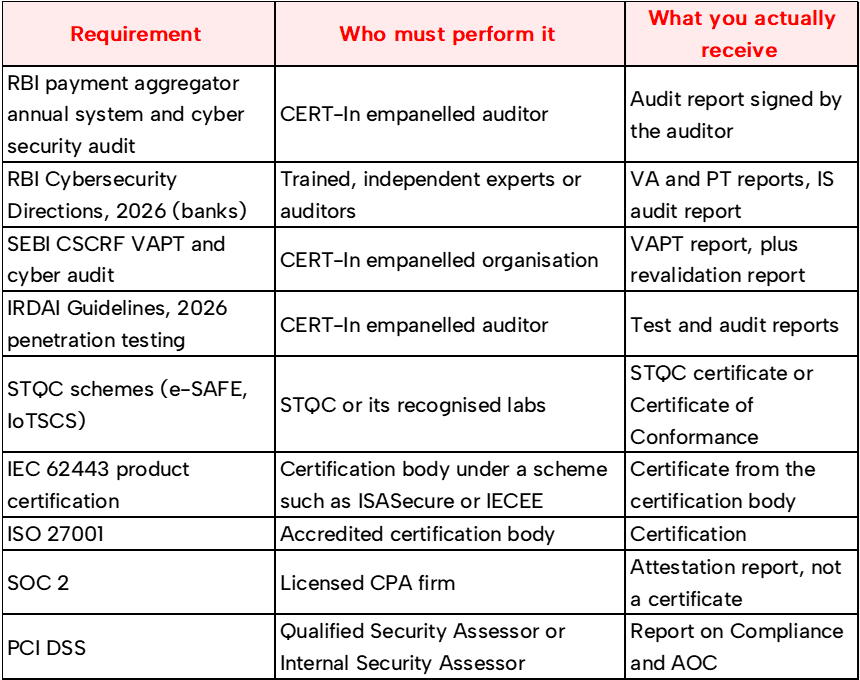
CERT-In empanelment is named in three rows. For everything else it is either misfit or the wrong credential. A CERT-In empanelled auditor cannot issue you a SOC 2 report. Only a CPA firm can.
What is CERT-In empanelment?
CERT-In, the Indian Computer Emergency Response Team, sits under MeitY. It runs an empanelment programme for information security auditing organisations. A firm applies, demonstrates technical competence, and if approved is added to a published list for a defined period, typically three years after which it must renew.
Empanelment is a statement about the auditor, not about you. It gives an organzation the term "auditor" whose competence the government has vetted, which is why
regulators lean on it. The report you receive is issued by that auditor, on the auditor’s letterhead. Its credibility comes from who signed it.
What does RBI require?
It depends on which licence you hold.
Payment aggregators. RBI’s Regulation of Payment Aggregators Directions, 2025 require an annual system audit, including a cyber security audit, by a CERT-In empanelled auditor. Your internal IT team cannot issue it, and neither can your statutory auditor.
Banks. On 31 July 2026 RBI repealed the 2016 cyber framework and the 2023 IT Governance Master Direction, and issued entity-specific Cybersecurity, Technology: Risk, Resilience and Assurance Framework Directions. For commercial banks these require vulnerability assessment at least every six months and penetration testing at least every 12 months on critical systems, conducted by appropriately trained and independent experts or auditors. The Direction is framed around independence and competence. It does not name CERT-In in the testing clause, though where a bank uses an empanelled auditor it must follow CERT-In’s audit guidelines. In practice, most banks’ third-party risk questionnaires still ask for an empanelled auditor.
NBFCs and others. Separate 2026 Directions cover NBFCs, small finance banks, payments banks, UCBs, AIFIs and CICs.
If you are unsure what your licence category requires, ask your supervisory contact. The cost of guessing wrong is a repeat audit.
What does SEBI CSCRF require?
SEBI’s Cybersecurity and Cyber Resilience Framework requires VAPT by CERT-In empanelled organisations, at least once a financial year, and after major releases.
What catches teams out is the calendar:
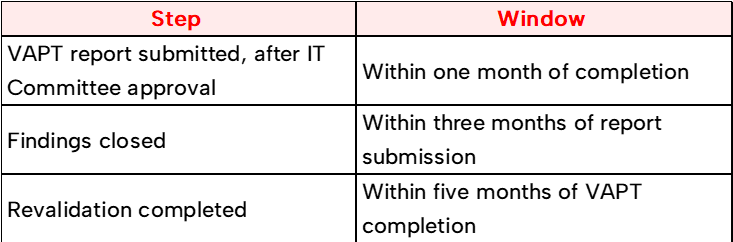
Read that as a project plan. If you commission the assessment two months before your deadline, you have already lost. Testing is the short part. Fixing and revalidating consumes the calendar.
What does IRDAI require?
IRDAI replaced its 2023 Guidelines with the Information and Cyber Security Guidelines, 2026 on 6 April 2026. Penetration testing of internet-facing systems moves to grey or white box, and must be conducted by a CERT-In empanelled auditor.
What certificate do you get after an IoT product security assessment in India?
For physical products, the difference between testing and certification is the whole question.

STQC, the Standardisation Testing and Quality Certification directorate under MeitY, issues its own certificates. For government procurement, particularly electronics tenders on GeM, a Certificate of Conformance is frequently non-negotiable.
IEC 62443 certification comes from a certification body such as exida, TÜV SÜD or TÜV Rheinland. A testing laboratory can run the assessment and issue a test report that feeds the certification, but the laboratory is not the certifying authority.
ISO/IEC 17025 is the standard most often misdescribed. Laboratories are accredited to it, not certified. In India, NABL accredits testing laboratories. Accreditation means the lab has shown competence for specific tests within a defined scope. It does not mean the lab can certify your product.
If a tender demands a third-party certificate, work out whether it wants a certification body’s certificate or an accredited laboratory’s test report. Turning up with the wrong one costs you the tender.
Where does CREST fit?
CREST is an international accreditation for security testing firms, asked for mainly by overseas customers. It is not a substitute for CERT-In empanelment in an Indian regulated audit, and CERT-In empanelment does not answer a customer questionnaire that names CREST.
Does the auditor’s empanelment have to be valid when the report is signed?
Yes. A firm that was empanelled when you signed the statement of work may not be on the day it signs your report. A report signed during a lapse is challengeable, and the remedy is to run the assessment again, at your cost and on your deadline.
Two checks protect you. Look the firm up on CERT-In’s published list yourself. Then confirm the validity date extends past the date you expect the report to be signed. If the cycle expires in between, ask for the renewal acknowledgement and a written commitment to defer sign-off until renewal is granted. Payatu’s current empanelment is listed at CERT-In, valid until 31st October 2027.
When do you not need a CERT-In empanelled vendor?
Empanelment is a regulatory credential for Indian regulated entities. It is not a general quality mark.
- SaaS selling to enterprises: your customer wants a credible penetration test report with real findings.
- SOC 2: a licensed CPA firm.
- ISO 27001: an accredited certification body.
- PCI DSS: a Qualified Security Assessor.
- FDA 510(k): no mandated tester; evidence quality, traceability and completeness matter.
- Pre-launch testing or validating a fix: empanelment has no bearing on whether the testing is good.
Ask in the right order. Who is forcing this assessment, and what have they asked for in writing? Then undergo the audit and achieve the reqiured certification.
What can you actually claim?
Describe what happened. Do not imply a mark you do not hold.

A penetration test is point-in-time, so every claim should carry the date and the scope. A clean report on version 4.2 says nothing about version 5.0. Vague claims fail diligence. Specific, dated, scoped claims survive it.
What should you verify before you sign?
- The firm appears on CERT-In’s current published list. Check it yourself.
- The empanelment validity extends beyond your expected report signature date.
- The deliverable is the specific artefact your regulator, tender or customer named, and it is named in the statement of work.
- Revalidation is included. Under SEBI CSCRF the retest is mandatory
Send us the clause
Payatu is CERT-In empanelled and ISO/IEC 17025 accredited. Send us the clause you have been given, and our team will tell you which document it asks for, including when the answer is that you do not need us for it. If you would like to see a redacted sample report first, ask for one in the same message. https://payatu.ai/contact-us


Questions Web Application teams ask us.
Keep Reading





We break browsers before someone else does
This is the default text value

